Standard Table Tennis Table Size: Official Dimensions and Markings
The standard table tennis table size is 2.74m long and 1.525m wide, with the playing surface 76cm above the floor. Here are the official specs.
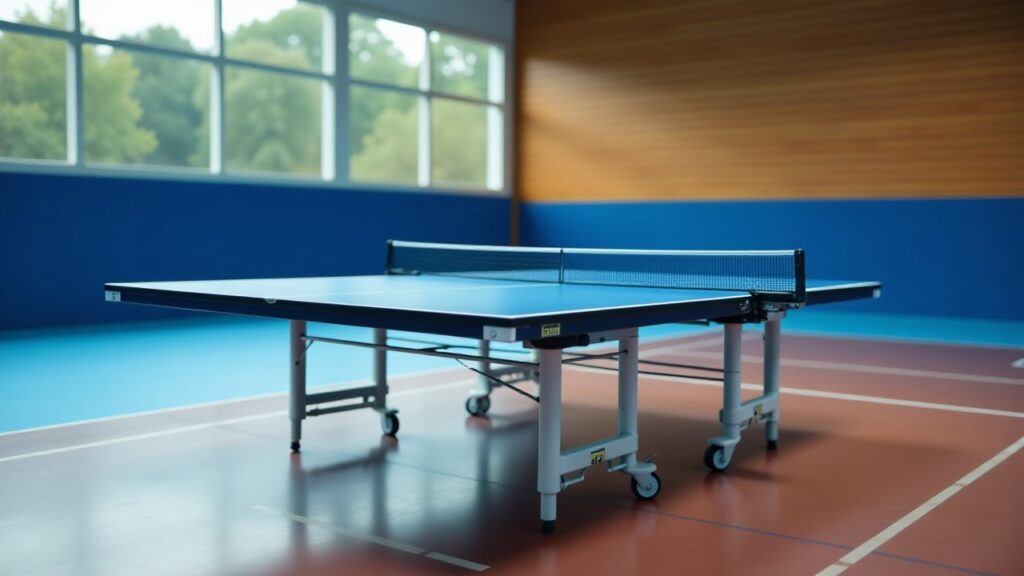
The standard table tennis table size is 2.74m long and 1.525m wide, and the playing surface sits 76cm above the floor. Those figures come from the Laws of Table Tennis, which are part of the Statutes of the International Table Tennis Federation (ITTF). The net across the middle stands 15.25cm above the surface along its full length.
The sections below cover the official dimensions, the bounce standard, the line markings, the net, the ball, and the playing space that ITTF regulations set for international competitions.
Official Playing Surface Dimensions
The ITTF Laws refer to the top of the table as the playing surface. Its requirements are:
- Shape: rectangular
- Length: 2.74m
- Width: 1.525m
- Height: 76cm above the floor, on a level, horizontal plane
The Laws also state that the vertical sides of the tabletop are excluded from the playing surface.
No particular material is required. Manufacturers may use any material, provided the surface meets the bounce standard described next.
The Bounce Test
The Laws set out a simple test for the surface. A standard ball is released from 30cm above the table, and it should rebound to roughly 23cm. The rebound has to be uniform across the playing surface.
Colour and Line Markings
The whole playing surface must be one dark colour throughout, with a matt finish. White lines are then marked on it:
- Side lines: 2cm wide, one along each of the two long 2.74m edges
- End lines: 2cm wide, one along each of the two short 1.525m edges
- Centre line: 3mm wide, parallel to the side lines, used for doubles
The centre line splits each court into two equal half courts for doubles. Under the Laws, the line itself belongs to each right half court. In doubles, the serve must travel from the server’s right half court to the receiver’s right half court.
A vertical net, parallel to the end lines, divides the playing surface into two equal courts. The Laws require each court to be continuous across its entire area.
Net Height and Net Posts
The net assembly covers the net, whatever suspends it, and the posts that hold it up, plus the clamps fixing those posts to the table. The ITTF Laws give these measurements:
- Net height: 15.25cm above the playing surface, measured at the net’s top edge across its whole length
- Posts: the net is held up by a cord running to an upright post at each end, and each post is 15.25cm tall
- Post position: each post’s outer edge sits 15.25cm beyond the side line
- Bottom edge: the bottom of the net runs as near to the surface as it can, and each end of the net is fastened to its post along the full height
The Laws also cover a ball that goes through the net, slips between the net and a post, or passes under the net between it and the surface. In each of those cases, the player who hit it loses the point.
The Official Ball
The ITTF Laws also define the ball used on the table:
- Shape: spherical
- Diameter: 40mm
- Weight: 2.7g
- Material: plastic
- Colour: white or orange, with a matt finish
How Much Space Does a Table Need?
ITTF regulations for international competitions set a minimum playing space around the table. The space can take any shape, but it must be no smaller than a box with these measurements:
- Length: 14m
- Width: 7m
- Height: 5m
Smaller spaces are allowed for some events:
- Wheelchair events: may be reduced, but to no less than 8m long and 6m wide
- Masters events: may be reduced, but to no less than 10m long and 5m wide
The playing area is closed in by surrounds. Under the regulations, each surround is between 50cm and 100cm tall, and all of them share one dark background colour. The corners of the area may be left open.
Lighting and Background
The same regulations also cover lighting for World, Olympic and Paralympic title events and other major events:
- The light intensity should be at least 1800 lux vertical and 2000 lux horizontal, applied evenly over the playing surface and playing area.
- In the warm-up and practice hall, it should be at least 1000 lux over the tables.
- The light source must be 5m or more above the floor.
- When several tables are in use, the lighting level must be the same for all of them.
The background behind the playing area should be generally dark, without bright light sources or daylight coming through uncovered windows.
Rules for Wheelchair Play
ITTF regulations add one table requirement for wheelchair players: the legs need to sit 40cm or more back from each end line.
Checking a Table Against the Standard
To compare a table with the ITTF Laws, check these five points:
- The top measures 2.74m by 1.525m.
- The playing surface is 76cm above the floor.
- The surface is one dark, matt colour, with 2cm white side and end lines and a 3mm white centre line.
- The net stands 15.25cm high, on posts whose outer edges sit 15.25cm beyond the side lines.
- A ball dropped from 30cm rebounds uniformly to about 23cm.
Frequently Asked Questions
How tall is a standard table tennis table?
The ITTF Laws put the playing surface 76cm above the floor. The top of the net is a further 15.25cm above the playing surface.
What is the white centre line used for?
The 3mm centre line divides each court into two half courts for doubles. In doubles, the serve must go from the server’s right half court to the receiver’s right half court, and the line counts toward each right half court.
Do the sides of the table count as part of the playing surface?
No. The ITTF Laws state that the vertical sides of the tabletop are not part of the playing surface.