The Offside Rule in Soccer Explained Simply
The offside rule explained in plain English: what an offside position is, when it becomes an offence, the key exceptions, and what the referee awards.

Under the offside rule, a player is in an offside position when some part of their head, body or feet is in the other team’s half and is closer to the other team’s goal line than the ball and the second-last opponent. Simply being in that spot breaks no rule. The player is only penalised if, after a team-mate plays or touches the ball, they go on to take part in active play.
The rule is Law 11 of the Laws of the Game, which are written and maintained by The IFAB. The sections below take it apart piece by piece: the position, the offence, the exceptions and the restart.
What Counts as an Offside Position
Law 11 sets two conditions, and a player has to meet both of them to be in an offside position.
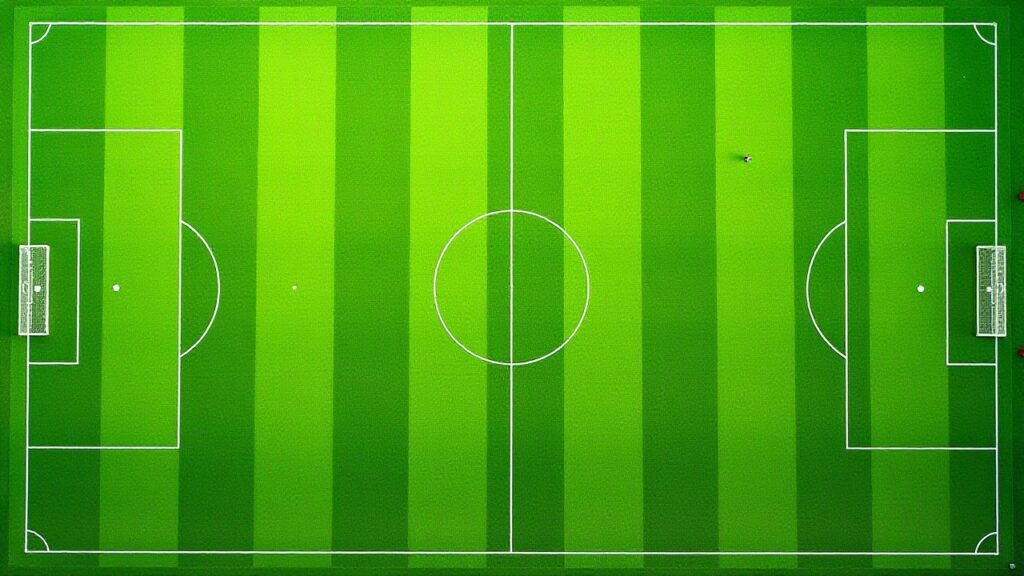
- Position on the field: part of the player’s head, body or feet has crossed into the opposing half. The halfway line itself does not count as part of that half.
- Position relative to others: part of the player’s head, body or feet is closer to the opposing goal line than the ball is, and also closer than the second-last opponent.
The second-last opponent
The Law measures against the second-last opponent, not the last one.
Level does not count
A player who is exactly in line with the second-last opponent is not in an offside position. The same is true for a player in line with the final two opponents. Because the attacker also has to be ahead of the ball, a player who is level with the ball or behind it cannot be in an offside position either.
Arms and hands are ignored
When the position is judged, the hands and arms of every player are left out, and Law 11 says this includes goalkeepers. Only the head, body and feet are used to decide who is further forward.
Your own half is safe
The first condition needs the player to be in the opposing half. A player who is entirely in their own half is therefore never in an offside position.
When Offside Becomes an Offence
The key moment is when a team-mate plays or touches the ball. The referee looks at where the player was at that instant. If the player was in an offside position then, they are penalised only if they become involved in active play. Law 11 sets out three ways this can happen.
Interfering with play
The player plays or touches a ball that a team-mate has just passed or touched.
Interfering with an opponent
A player can also commit the offence without touching the ball. Law 11 lists these actions:
- stopping an opponent from playing the ball, or from being able to play it, by clearly blocking the opponent’s view
- challenging an opponent for the ball
- clearly trying to play a ball that is near them, when that attempt affects an opponent
- making an obvious move that clearly affects an opponent’s ability to play the ball
Gaining an advantage
The third way is to gain an advantage by playing the ball, or by interfering with an opponent, after the ball has:
- bounced or deflected off a goalpost, the crossbar, a match official or an opponent
- been deliberately saved by any opponent
Deliberate Play and Saves
Law 11 draws a line between an opponent deliberately playing the ball and an opponent making a save.
If an opponent deliberately plays the ball, including through a deliberate handball, and it then reaches a player in an offside position, that player is not treated as having gained an advantage. The one exception is a deliberate save.
The Law defines a save as a player stopping a ball, or trying to stop it, when it is heading into the goal or very close to it. A save is made with any part of the body apart from the hands or arms, and a goalkeeper inside their own penalty area is the exception, since they may use their hands or arms. So a player in an offside position who plays the ball after an opponent’s deliberate save can still be penalised for gaining an advantage.
Situations Where Offside Does Not Apply
Three restarts are exempt. A player cannot commit an offside offence by receiving the ball straight from:
- a goal kick
- a throw-in
- a corner kick
A defender who steps off the field
Under Law 11, a defending player who goes off the field without the referee’s permission is counted as standing on the goal line or touchline when offside is judged. This continues until play next stops, or until the defending team plays the ball toward the halfway line and the ball is outside that team’s penalty area.
The Restart for an Offside Offence
The referee gives an indirect free kick for an offside offence. The kick is taken from the spot where the offence happened, and Law 11 makes clear that this is still the case when that spot lies in the offending player’s own half.
Who signals offside
Law 6 lists the duties of the assistant referees, and one of them is to signal when a player in an offside position may be penalised. Law 6 also states that the final decision always rests with the referee.
A Rule as Old as the Laws
According to FIFA’s timeline of the early Laws, offside was introduced in 1863, the year the first Laws were agreed. The same timeline dates goal kicks to 1869 and corner kicks to 1872. Those are two of the three restarts from which a player cannot commit an offside offence.
Quick Checklist
The parts of Law 11 above can be turned into four questions:
- When a team-mate played or touched the ball, was the player in the opposing half?
- Was part of their head, body or feet closer to the goal line than the ball, and closer than the second-last opponent?
- Did they then play the ball, interfere with an opponent or gain an advantage?
- Did the ball come directly from a goal kick, throw-in or corner kick? If so, there is no offence.
If the answers to the first three are yes and the fourth is no, the referee awards an indirect free kick.
Frequently Asked Questions
Is it offside if you are level with the defender?
No. Being in line with the second-last opponent, or with the last two opponents, does not put a player in an offside position. The player has to be closer to the goal line than the ball and than the second-last opponent.
Can you be offside from a throw-in?
No. Receiving the ball directly from a throw-in cannot lead to an offside offence. Goal kicks and corner kicks are treated the same way.
Can you be offside in your own half?
No. Part of the player’s head, body or feet must be in the opposing half, and standing on the halfway line does not count as being in that half.