Badminton Singles vs Doubles Rules: The Key Differences Explained
Badminton singles vs doubles rules differ in court lines, service courts and serving order. See how the BWF Laws treat each format, from scoring to faults.
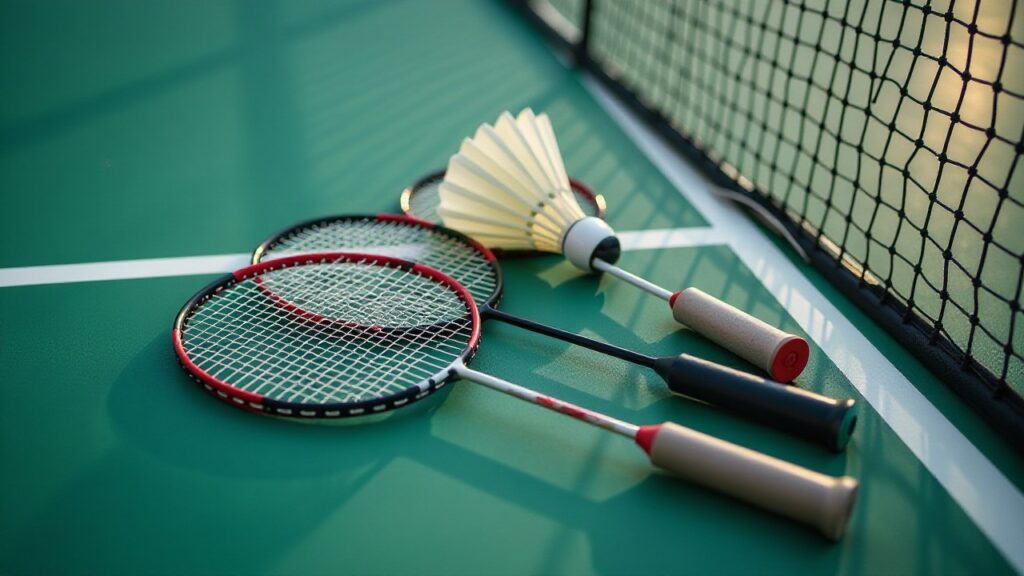
The main badminton singles vs doubles rules differences come down to three things: which court lines count, how the service court is chosen, and the order in which players serve and receive. For the service, singles uses a narrower but longer area, while doubles uses the full width of the court with a shorter service area. Scoring, the net, the shuttle and most faults are identical in both formats.
The Laws of Badminton, published by the Badminton World Federation (BWF), deal with singles in Law 10 and doubles in Law 11. This guide puts the two side by side.
What Stays the Same in Both Formats
Several rules do not change between the two formats:
- Scoring: rally point scoring to 21 applies in both. At 20-all a two-point lead is needed, and at 29-all the 30th point decides the game. Unless an event arranges otherwise, a match is the best of three games.
- The court: a note on Diagram A of the Laws confirms that one court layout serves both singles and doubles.
- The net and posts: in either format, the posts stand on the doubles side lines and the net height is the same.
- Service basics: at the moment of contact the whole shuttle must be lower than 1.15 metres, the racket must meet the base first, and server and receiver take up service courts that are diagonally opposite.
- Changing ends and intervals: identical rules apply to both.
Court Boundaries: Narrow and Long vs Wide and Short
The most visible difference is which lines mark the edge of play.
Singles boundaries
In singles, the inner side lines mark the sides of the court. Diagram A labels the back boundary line as the singles long service line too. A singles service can therefore reach as far as the back boundary line, but not into the side strips.
Doubles boundaries
In doubles, the outer side lines mark the sides of the court, which brings a 420 mm strip on each side into play. For the service, though, the doubles long service line is drawn 720 mm in front of the back boundary line. After the service has been returned, the whole court up to and including the back boundary line is in play.
Choosing the Service Court
Both formats use the score to decide where the server stands, but each counts it differently.
In singles
Law 10 keeps both players in their right service courts while the server’s score in that game is zero or an even-numbered total. An odd-numbered total sends both players to their left service courts. A server who wins the rally gains a point and serves next from the other service court. A receiver who wins the rally gains a point and takes over as server.
In doubles
Law 11 bases the service court on the serving side’s score: the right service court for zero or an even-numbered score, and the left service court for an odd-numbered score. More rules then follow:
- On the receiving side, the player who served last remains in the service court used for that service, and the partner occupies the other one.
- The receiver is whichever player stands in the service court diagonally opposite the server.
- Players switch service courts only after their side wins a point on its own service.
- When the serving side wins a rally, it gains a point and the same server moves to the other service court to serve again. When the receiving side wins, it gains the point and takes over the service.
The Serving Order in Doubles
In singles, the service simply passes to the other player whenever the receiver wins a rally. Doubles has a fixed rotation. Law 11 sets the order in which the right to serve moves during a game:
- The initial server, who begins the game from the right service court.
- Next, the initial receiver’s partner.
- Then the initial server’s partner.
- Then the initial receiver.
- Back to the initial server, with the cycle repeating.
Law 11 bars any player from serving or receiving out of turn, and from receiving two services in a row within one game. The only exceptions are the service court error rule in Law 12 and a fault called for misconduct. When a new game begins, the side that won the previous game may choose either player to serve first, and the side that lost may choose either player to receive first.
Hitting the Shuttle During a Rally
In singles, server and receiver take turns hitting the shuttle, from anywhere on their own side of the net, until it goes out of play.
In doubles, once the service has been returned, the two sides still take turns, but on each turn either partner may play the shuttle, from anywhere on their side of the net. Law 13 adds two faults that only arise in doubles:
- At the service, it is a fault if the receiver’s partner hits the shuttle.
- In a rally, a player and then that player’s partner may not hit the shuttle one after the other.
While the service is being delivered, Law 9 lets the doubles partners stand anywhere in their own courts, provided they do not block the opposing server’s or receiver’s view.
Service Court Errors
Law 12 defines a service court error as serving or receiving out of turn, or serving or receiving from the wrong service court. Once spotted, the error is put right at a moment when the shuttle is out of play, and the score reached up to that point is kept.
Singles and Doubles at the Olympic Games
According to the IOC Olympic Studies Centre, badminton joined the Olympic programme at Barcelona 1992 with four events: singles and doubles for men, and singles and doubles for women. A mixed doubles event was added and first held at the Atlanta 1996 Games.
Frequently Asked Questions
Is the badminton court the same size for singles and doubles?
Both formats use the same 13.400 m by 6.100 m court, but the boundaries differ. Singles uses the inner side lines, while doubles uses the outer side lines, adding a 420 mm strip on each side.
Why is the doubles service area shorter than in singles?
The doubles long service line sits 720 mm in front of the back boundary line, so a doubles service must land shorter. In singles, the back boundary line itself serves as the long service line.
Can both doubles partners hit the shuttle in one rally?
Yes. Either partner may play the shuttle during a rally, but it is a fault if a player and that player’s partner hit it one after the other.