Badminton Court Dimensions: Official Measurements from the BWF Laws
Badminton court dimensions per the BWF Laws: a 13.400 m by 6.100 m court, 40 mm lines, posts 1.55 m high and a net top 1.524 m high at the centre of the court.
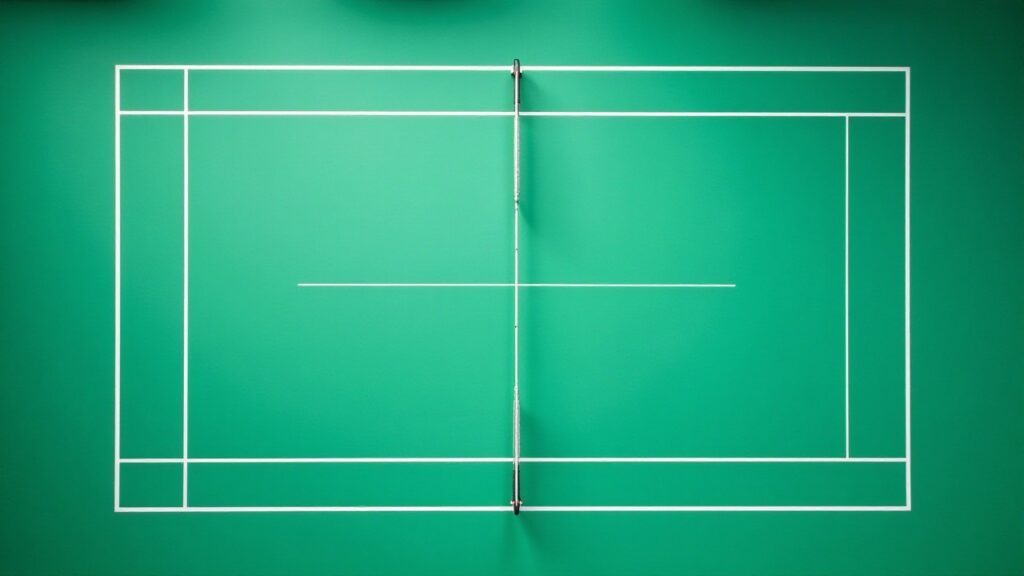
Official badminton court dimensions, as drawn in Diagram A of the Laws of Badminton from the Badminton World Federation (BWF), are 13.400 m long by 6.100 m wide. Every line on the court is 40 mm wide, and singles and doubles are played on the same court. At the centre of the court the top of the net stands 1.524 m above the floor, rising to 1.55 m where it crosses the doubles side lines.
Inside that outer rectangle, further lines mark out the service courts and the separate singles and doubles boundaries. This guide works through each measurement from Law 1 and Diagram A in turn.
The Outer Court and Its Lines
Law 1 sets the court as a rectangle and fixes the width of its marking lines at 40 mm. It asks for lines that stand out clearly from the floor, with white or yellow named as the preferred colours.
Law 1 also states that every line belongs to the area it marks out. A shuttle landing on a line is therefore inside the area that the line bounds. Diagram A lists the 40 mm width of each line as its own figure.
Overall length and width
Diagram A gives the full court as:
- Length: 13.400 m, back boundary line to back boundary line.
- Width: 6.100 m, doubles side line to doubles side line.
- Diagonal: 14.723 m for the full court, according to a note on the diagram.
Badminton Court Dimensions Along the Length
Each half of the court, from the net back, is split by the service lines. Diagram A shows these distances on both sides of the net:
- Net to short service line: 1.980 m, followed by the 40 mm short service line.
- Short service line to doubles long service line: 3.880 m, followed by the 40 mm doubles long service line.
- Doubles long service line to back boundary line: 720 mm, followed by the 40 mm back boundary line.
Added up on both sides of the net, these figures make the full 13.400 m length.
The back boundary line does two jobs. It is the rear edge of the court in every rally, and Diagram A labels it as the long service line for singles as well. For doubles, the long service line is the line drawn 720 mm in front of the back boundary line.
Badminton Court Dimensions Across the Width
Going across the court from one side to the other, Diagram A shows this sequence:
- A 40 mm doubles side line.
- A 420 mm strip.
- A 40 mm singles side line.
- A 2.530 m service court width.
- A 40 mm centre line.
- A 2.530 m service court width.
- A 40 mm singles side line.
- A 420 mm strip.
- A 40 mm doubles side line.
These parts together give the full 6.100 m width. The strips between the singles and doubles side lines belong to the doubles court only.
The service courts
In Diagram A, the centre line runs from the short service line back to the back boundary line, dividing each half into a left service court and a right service court. Law 9 places the server and the receiver in service courts that are diagonally opposite each other, and neither may touch the boundary lines of those service courts. A correct service has to land in the receiver’s service court, which has the short service line at the front, the centre line and side line on either side, and the relevant long service line at the back.
Net and Post Measurements
Law 1 gives detailed requirements for the net and posts:
- Posts: 1.55 m tall measured from the court surface, and they must stay upright when the net is tensioned.
- Post position: on the doubles side lines for both singles and doubles. Neither the posts nor their supports may reach into the court past the side lines.
- Net material: a fine, dark-coloured cord of even thickness.
- Net mesh: Law 1 sets the mesh size between 15 mm and 20 mm.
- Net size: 760 mm deep and a minimum of 6.1 m wide.
- Top tape: a white tape 75 mm wide, folded over a cord or cable that passes through it, with the tape sitting on that cord or cable.
- Net height: measured from the court surface, the top of the net is 1.524 m at mid-court and 1.55 m above the doubles side lines.
Law 1 requires the cord or cable to be pulled tight so that it sits level with the tops of the posts. It also calls for the net to meet the posts without gaps, and where needed the net’s full depth at each end is tied to the posts.
Testing Marks on the Court
Diagram B of the Laws shows optional testing marks near the back of the court. These marks make the speed test easier to read. Law 3 describes that test: a shuttle struck with a full underhand stroke from above one back boundary line should come down between 530 mm and 990 mm before the far back boundary line if its speed is correct.
One Court for Singles and Doubles
A note on Diagram A confirms that the one court layout serves both singles and doubles. The two formats simply use different boundaries:
- Singles: the inner singles side lines mark the sides, and the back boundary line also acts as the long service line.
- Doubles: the outer doubles side lines mark the sides. The doubles long service line limits the service, while the back boundary line marks the end of the court during rallies.
The Laws also contain separate court diagrams for Para badminton. Wheelchair badminton has its own layouts, and standing classes playing half-court singles use another diagram, while the other standing classes play on the standard court.
Frequently Asked Questions
What are the full dimensions of a badminton court?
Diagram A of the BWF Laws shows a court 13.400 m long and 6.100 m wide, marked with 40 mm lines. A note on the diagram gives the full-court diagonal as 14.723 m.
How high is the net on a badminton court?
The top of the net is 1.524 m above the court surface at mid-court and 1.55 m above the doubles side lines. The posts are 1.55 m tall.
How far is the short service line from the net?
Diagram A shows a distance of 1.980 m from the net to the short service line on each side, with the 40 mm width of the line itself following that distance.