What Is Esports? A Plain Guide to Competitive Video Gaming
What is esports? A plain guide to competitive video gaming: how official bodies define it, who governs it, how national teams form and how fair play works.
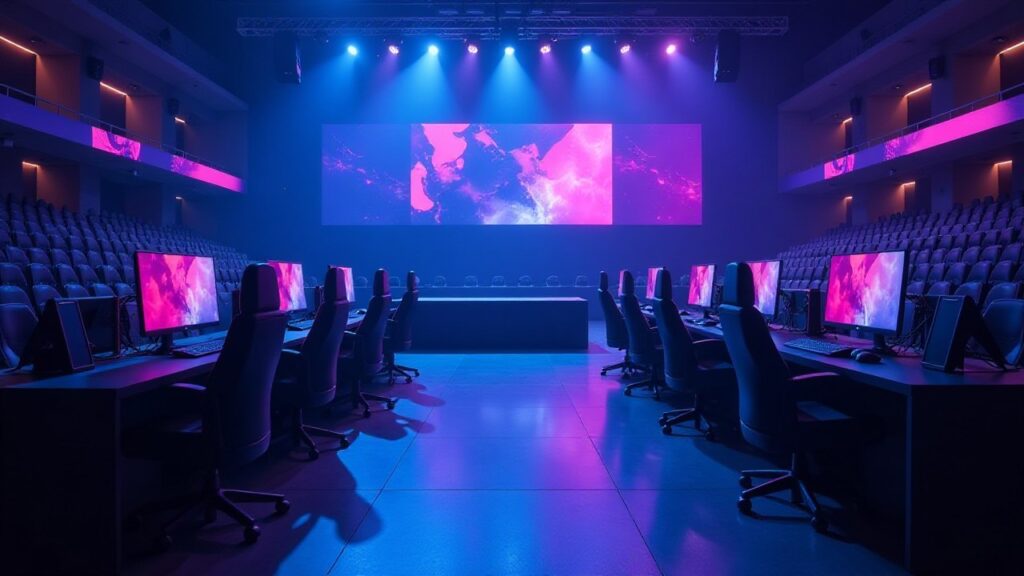
Esports is competitive play on electronic devices, organised as contests between players or teams. The Asian Electronic Sports Federation (AESF) calls it “the combination of Electronic and Sports” and explains that the electronic device serves as the platform on which the competition takes place. Players take part in tournaments where, according to the AESF, they compete for medals, prize money or both.
How Official Bodies Define Esports
The AESF definition is broad. Beyond ordinary video games, it extends to simulation, virtual reality, augmented reality, robots, unmanned vehicles and drones, as long as a person drives the action through a human or human-computer interface.
The same AESF page notes that its tournaments draw audiences both online and in venues. It also lists skills that players can build through esports: logical thinking, quick reactions, hand-eye coordination and a sense of team spirit.
Who Governs Esports
Like other sports, esports has international and regional federations that write standards and stage championships.
- International Esports Federation (IESF). Founded in Seoul in 2008 as the first international esports federation, the IESF has its headquarters in Busan, South Korea. Its stated mission is to promote esports as a legitimate sport, to encourage cooperation between nations and to set global standards for competitive gaming.
- Global Esports Federation (GEF). The GEF lists five values, namely equality, fair play, diversity, inclusion and innovation, and it names establishing an athlete commission focused on wellness and career support among its core objectives.
- Asian Electronic Sports Federation (AESF). The AESF presents itself as the sole competent authority for esports across Asia and states that the Olympic Council of Asia recognises it in that role.
How National Teams Are Formed
At federation championships, players compete for their countries. The IESF regulations for one of its world championships give a clear picture of how this works.
Each national team is put together by the national federation of that country, which has both the right and the duty to choose its own players. The federation must use a reasonable process, either looking at players’ rankings and past results or holding a national qualifier, and the IESF strongly recommends qualifiers for every title. Every member of a national team must hold citizenship of the country on the shirt, and the team carries the name of its nation. Players wear a national uniform that their federation designs, with a national emblem, the federation logo or the flag on the left chest.
Players and delegation members under 18 must travel with a responsible adult, who may be another member of the same delegation.
What an Official Match Looks Like
The IESF rulebooks cited here set playing conditions so that competitors have the same setup.
- Equipment. The same IESF world championship regulations set minimum computer specifications, require identical software on every player’s machine and ban programs that the match does not need.
- Network. An IESF world championship rulebook for a five-a-side mobile title states that all matches run on official tournament servers, with every player on the same local network so that conditions are equal.
- Referees. Referees rule on problems during play. Under the IESF world championship regulations, a disputed referee decision goes first to the event Jury, then to a Protest Deliberation Committee, and finally to the IESF Board.
- Formats. In the mobile rulebook mentioned above, group matches are best of three, and the medal matches are best of five.
Fair Play and Integrity
The IESF Code of Conduct covers everyone involved in its events, from players and coaches to officials, staff, volunteers and fans. It asks competitors to show good sportsmanship, to stay within the rules and to give full effort in every match, never losing on purpose.
The code also bans cheating in all its forms, including unauthorised programs, modified hardware, abuse of bugs, aiming aids, tools that reveal hidden opponents, scripts and automation. Trying to influence the result of a match is forbidden too. Depending on how serious a breach is, the response can be a warning, disqualification, a suspension or a lifetime ban.
Doping rules apply as well. The IESF says it follows the World Anti-Doping Code, that athletes at its events may be tested, and that each athlete must check any medicine or supplement against the WADA Prohibited List.
Esports at the Asian Games
Esports has moved into multi-sport competition. According to the AESF, esports first appeared as a demonstration event at the 2018 Asian Games in Jakarta. It then became a medal event for the first time at the 19th Asian Games in Hangzhou, where seven gold medals were contested across seven titles.
The AESF reports that 30 National Olympic Committees and 473 athletes took part in Hangzhou, with 21 medals decided over 219 matches.
Frequently Asked Questions
How do official bodies define esports?
The Asian Electronic Sports Federation describes esports as the meeting of electronics and sport, with competition played on electronic devices, and its definition also covers simulation, virtual reality and robots controlled by people.
Who governs esports internationally?
International federations such as the International Esports Federation and the Global Esports Federation set standards and run championships, while regional bodies like the AESF and national federations organise competition closer to home.
Has esports been part of the Asian Games?
Yes. The AESF reports that esports was a demonstration event at the 2018 Asian Games in Jakarta and became a medal event for the first time at the 19th Asian Games in Hangzhou.