Basketball Positions Explained: The Five Roles on the Court
Basketball positions explained simply: what the point guard, shooting guard, small forward, power forward and center each do, plus the rules behind them.
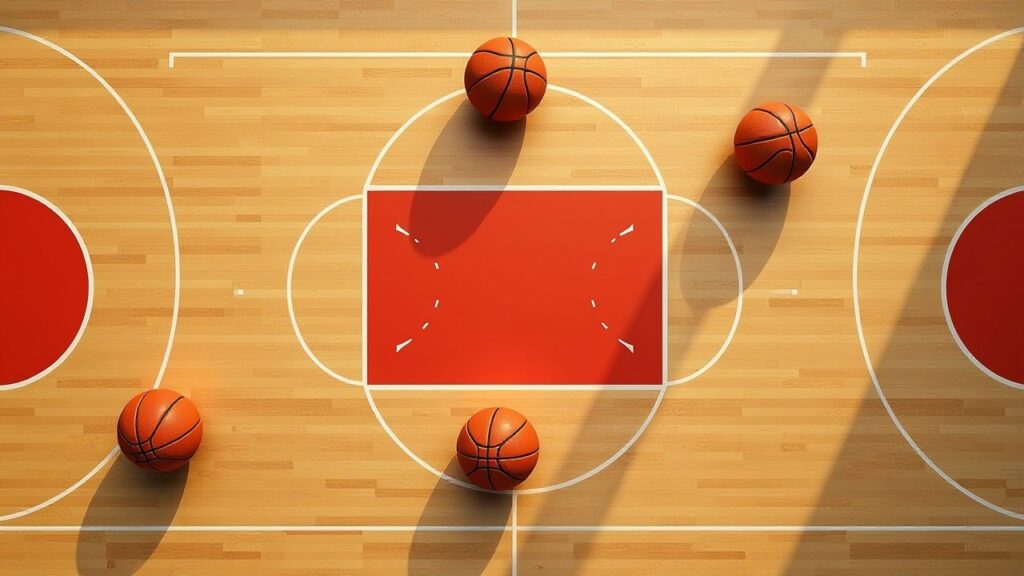
Each basketball team has five players on the court, and the NBA’s youth basketball guide names five positions for them: point guard, shooting guard, small forward, power forward and center. Each position comes with its own typical duties, from running the offense to rebounding near the basket. The official rulebooks, however, do not assign positions at all, so these labels describe roles rather than legal requirements.
Five Players on the Floor
Both major rulebooks begin with the same number. The NBA Official Rulebook sets each team at five players and does not allow a team to drop below five. The FIBA Official Basketball Rules describe a game between two teams with five players apiece, where each side tries to put the ball through the opponents’ basket and keep the other side from doing the same.
FIBA also explains who counts as what during playing time. A team member on the court who is entitled to play is a player. One who is entitled to play but sitting off the court is a substitute. Someone who has reached five fouls becomes an excluded player and can no longer take part. Under FIBA rules, a team may list no more than 12 team members who are entitled to play.
Point Guard
According to the NBA’s youth basketball guide, the point guard is the player who runs the offense. This player is usually the best dribbler and the best passer on the team. On defense, the point guard matches up with the other team’s point guard and looks for chances to steal the ball.
Shooting Guard
The same guide describes the shooting guard as, in most cases, the team’s best shooter. A shooting guard is expected to be accurate from long distance and to be a strong ball handler as well.
Small Forward
The small forward takes on opponents of every size, guarding both smaller and bigger players. The guide says this player moves all over the court rather than staying in one area. Small forwards are able to score from long range and from close to the basket.
Power Forward
The power forward handles many of the same tasks as the center. That means working close to the basket, collecting rebounds and defending taller opponents. What sets the power forward apart, according to the guide, is that this player shoots from farther out than a center normally does.
Center
The center is normally the team’s tallest player and works close to the basket. When the team has the ball, the center looks to score on short shots and to grab rebounds. When the other team has the ball, the center tries to block shots and to collect the rebounds from the opponents’ misses.
What the Rules Say About Roles
Neither rulebook ties a player to a position. The rules that do shape where players stand and who they guard are these.
Any defender can guard any attacker
Under the NBA rulebook, a defender is free to guard whichever attacker they choose, and defenders are also allowed to double-team any player. The rule makes no mention of positions.
Three-second limits
An attacking player cannot stay in the area near the opponents’ basket for longer than three seconds while their team has control of the ball. In the NBA, that area is the free throw lane. Under FIBA rules, it is the restricted area, and the count applies while the team controls a live ball in its frontcourt with the game clock running.
The NBA adds a rule for defenders. A defensive player standing in the 16-foot lane, or in the zone that reaches 4 feet beyond the lane endline, has three seconds to begin actively guarding an opponent. To count as actively guarding, the defender has to be in a guarding stance and close enough to touch the opponent at arm’s length.
Starting Lineups and Substitutions
Naming the starters
The five starters are named before tip-off, but not by position. In the NBA, the scorers must receive each starter’s name and number no later than 30 minutes ahead of the scheduled start. Under FIBA rules, each head coach signs the scoresheet and names the five starting players no later than 10 minutes ahead of the game.
Changing players in the NBA
An NBA substitute first reports to the scorer, says which player is being replaced, and waits near the 8-foot substitution box in front of the scorer’s table. The substitute may not step onto the court until an official waves them on. Once that happens, the substitute is counted as being in the game.
Changing players under FIBA rules
A FIBA substitute stays outside the boundary line until the referee whistles, signals the change and beckons the player onto the court. The player coming off may walk straight to the bench without reporting to anyone.
Fouling out
In the NBA, a sixth personal foul disqualifies a player. If every substitute has already been disqualified, the player stays in the game, but each further personal foul is also charged to the team as a technical foul. Under FIBA rules, a player who reaches five fouls must be replaced at once, with no more than 30 seconds allowed for the change.
Frequently Asked Questions
How many positions are there in basketball?
The NBA’s youth basketball guide lists five: point guard, shooting guard, small forward, power forward and center. Each team also has five players on the court.
Do the rules require a team to play each position?
No. The NBA and FIBA rulebooks require five players on the court for each team, but they do not assign positions. The NBA rulebook also lets any defender guard any attacker.
Which basketball position is usually the best dribbler?
The point guard. According to the NBA’s youth basketball guide, the point guard directs the team’s attack, and the player in that role is often its top ball handler and passer.