Wai Kru Meaning: The Ritual Before Every Muay Thai Bout
The wai kru meaning is "paying respect to the teacher." Learn why muay thai athletes perform it, what the ram muay dance shows, and what IFMA rules require.
The wai kru meaning is, put simply, “paying respect to the teacher.” “Wai” is the Thai gesture of respect made with the palms pressed together, and “kru” (also spelled khru) means teacher. In muay thai, the wai kru is the ritual an athlete performs in the ring before the first round to honour their teachers.
Under IFMA rules, every athlete must perform it, and IFMA also runs separate competitions in which the ritual itself is judged.
The Words Behind the Ritual
Each of the two Thai words carries weight.
- Wai: the Thai gesture of joining the palms and bowing. In a ceremony that honours teachers, the wai is deeper and more formal than an everyday greeting, and it expresses respect and a hope of receiving blessings.
- Kru: teacher. In Thai, the word has a broad sense of someone deserving respect, such as an instructor or an advisor, not only a classroom teacher.
The ring ritual links to a wider Thai custom. Thai schools hold their own Wai Khru ceremonies, where students show gratitude and respect to their teachers. In muay thai, the same word names the ritual that fighters perform for their own teachers.
What the Wai Kru Honours
Thai cultural material explains that fighters use the ritual dance to show respect for the Buddha, the dharma, the sangha, their masters and their parents. It also acts as a warm-up. On top of that, it lets fighters show their lineage, since each lineage of muay thai has its own wai kru movements, handed down from teacher to student.
IFMA’s rulebook treats the wai kru as a required pre-bout mark of respect.
How the Ritual Unfolds
Thai cultural material describes the order of the ritual. Before the dance begins, fighters walk around the ring counter-clockwise and stop at each of the four corners to bow three times, out of respect for the Buddha, the dharma and the sangha. They then start the dance itself by kneeling and bowing to their masters, their parents and the spiritual forces they revere.
Wai Kru and Ram Muay
The two terms often appear together, as in the phrase wai kru ram muay. IFMA’s rules treat them separately: the wai kru is required before every bout, while the Rai Ram Muaythai dance is allowed only in finals.
There is also a ring-sealing ritual, which IFMA calls Krob Kru. Under its rules, athletes may perform it before the wai kru only in finals.
Sacred Items: Mongkon and Prajiad
Two items appear during the ritual.
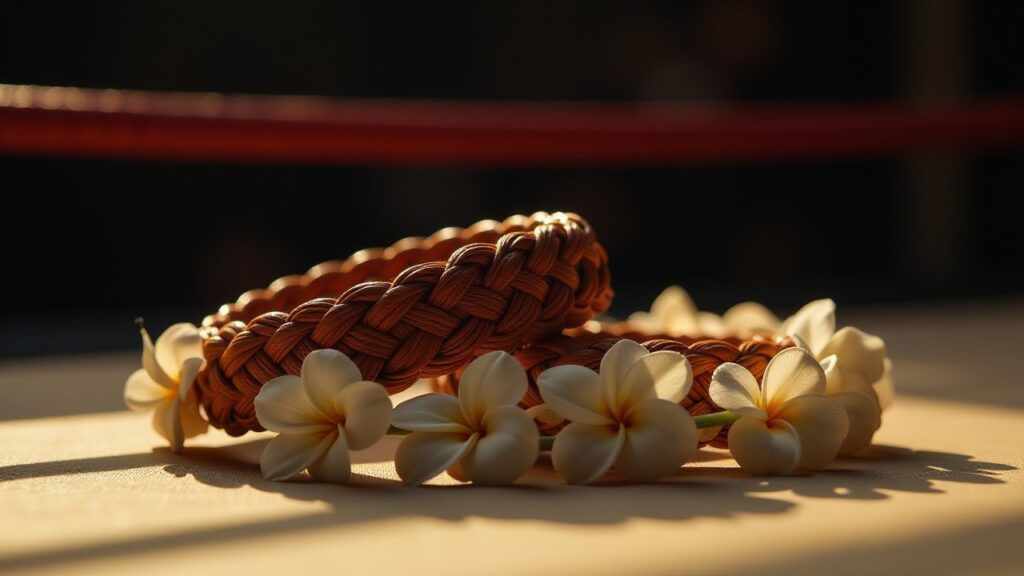
Mongkon: a sacred headband worn during the wai kru. Thai cultural material notes that a fighter’s masters place it on the fighter’s head, often while reciting incantations, and that some are made from materials such as burial shrouds or pieces of revered monks’ robes. IFMA requires athletes to wear the Mongkon while they pay homage in the wai kru. After entering the ring, the athlete’s second puts it on their head.
Prajiad: a pair of armbands worn during the wai kru dance, often made from materials with occult meaning. IFMA lets athletes wear an armband with an amulet or charm on the upper arm or at the waist, provided it is neatly covered and does not hold up the bout by coming loose.
The Music
Thai cultural material names the pi klong ensemble as the music for muay thai bouts: an oboe called the pi chawa, a pair of drums called the klong khaek, and a cymbal called the ching. The wai kru melody, Yone Plaeng, is solemn and fearsome in tone. IFMA’s rules list matching instruments, two drums, small cymbals and a java pipe. When no live band is on hand, IFMA allows recorded muay thai music.
What IFMA Rules Require
In IFMA competition, every athlete has to perform the wai kru. The rulebook sets out these requirements:
- Each athlete performs the wai kru before the first round.
- The minimum is two starting postures, Thep Pa Nom and Kom Krab, plus three bows to the canvas while wearing the Mongkon.
- IFMA invites athletes to go beyond that minimum and complete all six starting postures.
- Rituals from other martial arts are not permitted.
- In preliminary bouts, the wai kru may last no more than two minutes, and the referee signals when it ends.
- The Rai Ram Muaythai dance is reserved for finals.
IFMA also holds stand-alone Wai Kru competitions, where judges mark the ritual as a performance. They deduct points for faults in authenticity, completeness of the postures, rhythm, fluidity, personality and costume. IFMA describes these events as highlighting muay thai’s cultural heritage.
How to Watch a Wai Kru
If you are new to muay thai, watch the wai kru closely instead of treating it as a gap before the action. Look for:
- The bows, first at the corners of the ring and then kneeling.
- The movements of each fighter, which reflect the lineage passed down by their teachers.
- The Mongkon headband, which IFMA requires during the wai kru.
- The music, played on the oboe, drums and cymbal.
Knowing the wai kru meaning helps explain the respect that runs through muay thai. IFMA’s rules carry it beyond the ritual too: athletes must shake hands or give a “wai” both before the bout and after the decision.
Frequently Asked Questions
What does wai kru mean in English?
It roughly means “paying respect to the teacher.” “Wai” is the Thai gesture of respect with the palms together, and “kru” means teacher.
Is the wai kru the same as the ram muay?
The two are closely linked and often named together. IFMA’s rules treat them separately: the wai kru is required before every bout, while the Rai Ram Muaythai dance is allowed only in finals.
Do all muay thai fighters have to perform the wai kru?
In IFMA competition, yes. Every athlete must perform at least the required starting postures before the first round. Other events may follow their own customs.